

Southbound from West Seven
An Allman Brothers writing prompt, a smoky flat in W7 and the slow realisation that both me and my music had been heading south all my life.

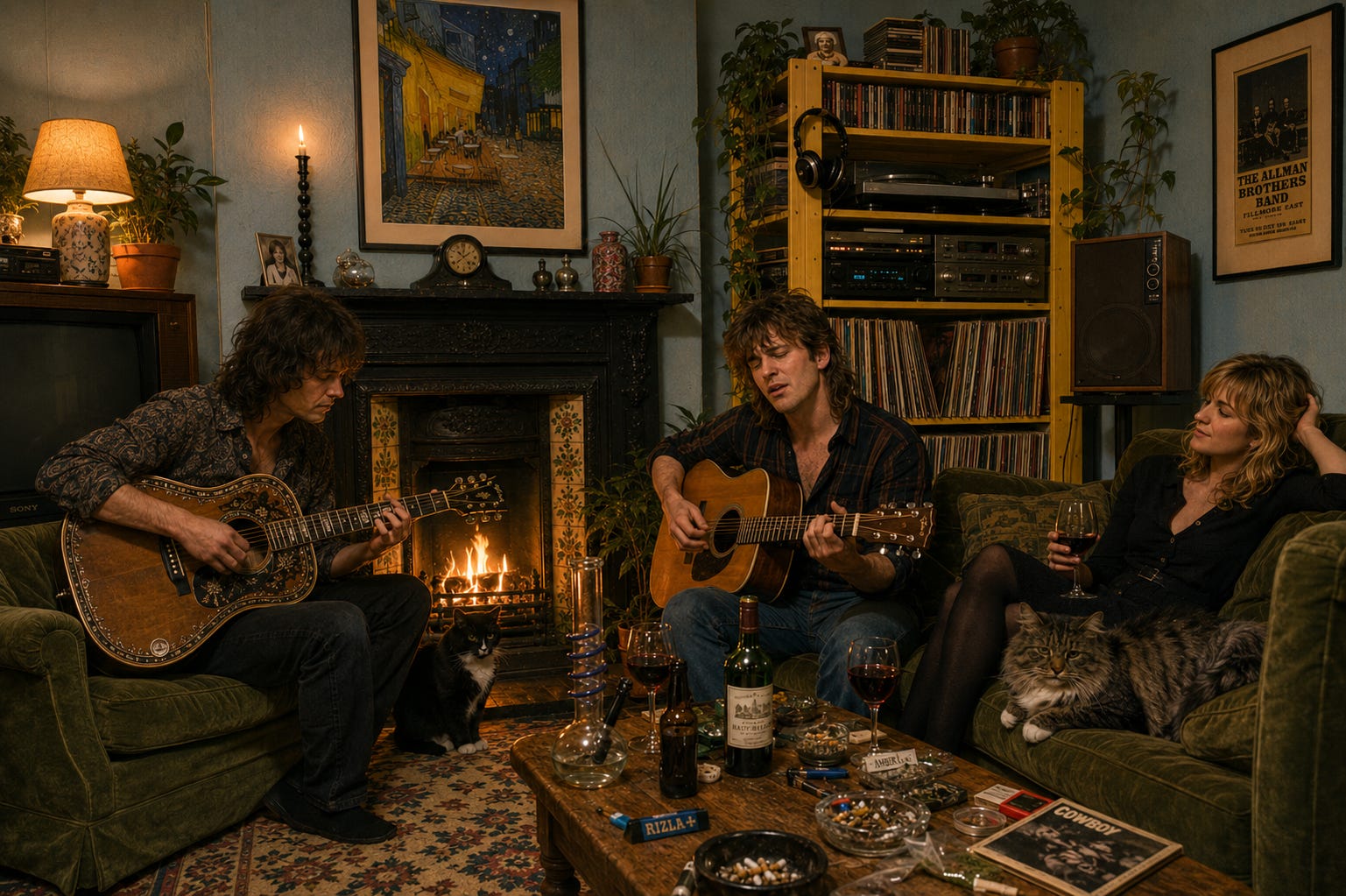
MJ Polk’s writing prompt for this week’s Stories from the Jukebox was Mountain Jam by the Allman Brothers Band, which presented me with a slight problem because, while I adore the Allman Brothers, this piece is not really about Mountain Jam at all. In fact, it took the prompt itself to finally make me realise something about my own music that I had never properly stopped to think about before.
A while back, dear Mr Polk mentioned in an email that my music “reeks of the South.” He meant it as a compliment, I think, though I remember scratching my head over it a little at the time because I’m a Londoner. Born and raised. West London. Grey skies, traffic fumes, tea, cigarette smoke and concrete. Hardly Alabama.
And yet, once I started thinking about it properly, I realised he was absolutely right.
The strange thing is, I never consciously set out to absorb Southern culture. It simply arrived in fragments throughout my life and quietly made itself at home. By the time I noticed it, the place had already been furnished.
The first thing younger readers, especially Americans, probably need to understand is just how grim Britain could feel during the seventies. People romanticise it now because memory softens the edges of things, but the country often felt exhausted back then. We had strikes, power cuts, three-day working weeks and a kind of lingering postwar austerity mentality hanging around long after the war itself had gone. Adults discussed sugar being “back in the shops” with the seriousness of military intelligence. Petrol rationing drifted in and out of ordinary conversation. London buildings still wore soot like a permanent overcoat, and half the country seemed to function on tea, cigarettes and industrial resentment.
Into all of that came the mythology of the American South. Not through politics, but through entertainment.
The Dukes of Hazzard arrived on television like a transmission from another planet. Smokey and the Bandit turned up at the cinema shortly afterwards with sunshine, fast cars, country music and Burt Reynolds grinning his way across enormous Southern landscapes. Clint Eastwood wandered around the South with an orangutan called Clyde. Daisy Duke probably altered the hormonal chemistry of half the Western world. Even the ordinary details looked exotic to us. Pickup trucks. Gas stations. Long highways. Roadside diners. Warm nights. The South looked huge, colourful and alive.
To a London kid growing up during power cuts and shortages, Georgia may as well have been Narnia.
I think that is probably why songs about “heading south” always affected me so deeply. If you live in London, the only genuinely southbound train available takes you to Brighton, which, despite Pete Townshend’s best efforts in Quadrophenia, is essentially pebbles, drizzle and mildly disappointing seawater. So when somebody like the Marshall Tucker Band sang about catching a southbound train, my imagination automatically filled in the blanks. South meant warmth. Space. Music. Somewhere emotionally expansive.
Can’t You See by the Marshall Tucker Band remains one of my favourite songs of all time. Which, if you think about it, is practically a psychiatric diagnosis at this point.
The South had already entered my life long before music fully got hold of me anyway. My father used to read me Br’er Rabbit stories when I was little, complete with the dialects and voices. I still have the book now. I devoured Mark Twain, plantation stories, Huckleberry Finn and anything remotely connected to the American South. Then came school history lessons about the Civil War. I had a brilliant history teacher who brought the whole thing alive, not through dates and battles, but through atmosphere and human stories. Later on I became fascinated by the photographs of Matthew Brady because the Civil War suddenly stopped looking like distant history and started looking like real people living through extraordinary times. Those photographs stayed with me for years.
At the same time, music was beginning to take over my life.
Like most kids of my generation, I desperately wanted a guitar. The problem was that we never really had spare money. We were never poor in the Dickensian sense. We always had food on the table, clean clothes and a roof over our heads, but there was no casual money for instruments lying around. Eventually, my mum bought me an acoustic guitar after working extra cleaning shifts in an Irish pub. Cleaning toilets, no less. The guitar itself was dreadful. Truly dreadful. High action like suspension bridge cables and probably built from whatever wood happened to be available at the time. No name on the headstock. No pedigree whatsoever.
But it held tune, and to me it was magnificent.
I sat there for years with Bert Weedon books trying to make sense of the thing. Bert Weedon taught an entire generation of British boys chord shapes while somehow never entirely explaining how those shapes became music. I learned the basics. E, A, D, G and a vague understanding that the F chord was probably invented by Satan himself.
Then my older brother accidentally changed my life.
He didn’t really play guitar either, but he knew older lads who did. Proper players. Band blokes. Every now and then he would come home and show me a chord one of them had taught him, and because I was desperate to learn anything at all, I clung to those scraps of knowledge like treasure.
One day he came home with the opening progression to Melissa by the Allman Brothers Band. Not even all of Melissa. Just the beginning. Those gorgeous suspended E-shape voicings sliding upwards in a way that sounded impossibly wistful and sophisticated to my young ears. Suddenly the guitar no longer sounded British. It sounded American. Southern somehow. Warm and melancholy.
That progression became my thing.
The funny part is that, after all these years, Melissa remains more or less the only cover version I can still properly play all the way through. I never became one of those guitarists with a repertoire of pub covers ready to go. I wanted to write songs, not reproduce somebody else’s. But Melissa stayed under my fingers forever.
Around the same time I discovered BB King through my parents’ copy of Live at the Regal and realised that I could just about manage pentatonic blues phrases over the top of those Melissa chords. I became one of those deeply strange musicians who can’t really play rock guitar properly but can happily sit in an E minor pentatonic box all night making emotional faces.
Oddly enough, that suited the Allman Brothers perfectly.
By my late teens and early twenties, Southern music had completely got hold of me. Not academically. I wasn’t one of those blokes cataloguing bootlegs and arguing over Fillmore East setlists. The music simply entered my bloodstream. Duane Allman, Gregg’s Hammond organ, Marshall Tucker, Waylon Jennings, Muscle Shoals, Bobby Whitlock, Cowboy, all of it. Looking at my record collection now in my mid-sixties, I realise that most of it is American music. Even half the British bands I loved wanted to be American. The Stones spent years pretending they had been born somewhere near the Mississippi Delta. Clapton emotionally relocated to the South long before his passport did.
Then along came Withnail. Not his real name, obviously, but spiritually accurate enough that it stuck.
He lived upstairs from us in West London during the late eighties. We called it West Seven back then, which was really just Hanwell with artistic ambitions and a slightly inflated opinion of itself, and our flats operated on what could best be described as an open-border arrangement. Music everywhere. Guitars permanently lying around. Tea, booze, joints, records, people drifting in and out at all hours. Withnail was an astonishingly good guitarist. Jazz first and foremost, then folk, then flamenco, because apparently ordinary hobbies were beneath him. He owned this beautiful handmade acoustic and a fabulous semi-acoustic jazz guitar that sounded incredible even unplugged.
More importantly, he had phenomenal taste in music. This was before the internet, remember. Music discovery happened socially. Somebody handed you a record and changed your life.
Through Withnail came Bobby Whitlock, deeper Allman Brothers cuts, Tim Buckley and all sorts of Southern soul and Americana that later seeped into my own songwriting without me fully noticing. In return, I turned him onto Cowboy and the album Five’ll Getcha Ten after discovering Duane Allman’s connection to them through one of the anthology collections. We were constantly passing records backwards and forwards like smugglers.
The strangest moment came when we both independently produced copies of White Mansions, this bizarre Civil War concept album featuring Waylon Jennings and various others. I have genuinely never met another human being who owned that album before or since. Yet there we were in a West London flat waving copies at each other in disbelief while the rest of Britain was probably listening to synth-pop.
That album became hugely important to me later because the song Bad Man fed directly into my own Cowboy Movie material decades afterwards. Again, Southern mythology quietly working its way into my imagination.
And every single time somebody handed me a guitar and said, “Go on then, play something,” I still only knew Melissa. So I would start doing my little progression, and Withnail would instantly leap in. “Ohhhh, Melissa!”
Then he would take over the chords properly while I noodled away with my BB King pentatonics over the top. The funny thing was, it worked beautifully because he couldn’t really play blues, and I couldn’t really play much else. Between us, we accidentally became a functioning Southern rock duo for the duration of several joints and half a bottle of red wine.
It was also through the Allmans that I fell in love with melodic bass playing. Berry Oakley completely changed how I heard the instrument. He wasn’t hiding at the bottom, obediently thumping root notes. He moved melodically, weaving through the guitars like another lead instrument, and any bass player willing to venture South of the fifth fret is always going to be a friend of mine.
Then there was Gregg’s Hammond organ. While everybody else air-guitared Duane solos, I was listening to Gregg.
The song Dreams nearly took my head off the first time I heard it properly. That huge swirling Hammond sound, part gospel, part blues, part ghost story, probably explains half my own musical instincts more clearly than anything else I have mentioned so far.
Then life arrived properly. Marriage. Work. Bills and parenthood, all looming on the horizon.
Twenty-seven years ago, my wife and I moved into the house I’m sitting in now. She was eight months pregnant with our first child, and the move itself was complete chaos. The previous owner had not fully vacated. The garage was inaccessible. Boxes were everywhere. Friends were trying to help. I, meanwhile, was quietly spiralling into an anxiety attack because I am a Cancerian and my carefully imagined moving-house routine had completely collapsed.
At some point my wife realised what was happening and took control.
She instructed Withnail and the others to recreate our old flat in the middle of the new living room. Furniture arranged exactly the same. Chair by the fire. Stereo set up. Familiarity restored.
Then she brought me a huge Jack Daniels and Coke and an absolutely lethal joint specifically designed to chemically tranquillise me.
One thing you learned very quickly with my wife was this: if she lovingly rolled you a spliff, you should immediately become suspicious.
Then she put Blue Sky on the stereo.
Somewhere inside this makeshift reconstruction of our old life, Blue Sky drifted around the room like warm weather while the panic slowly dissolved. Later on, after the whiskey and Jo’s dangerously therapeutic spliff had finally done their work, Withnail picked up the guitars, and before long, we were back inside Melissa yet again. Outside that room waited adulthood, mortgages, cardboard boxes and impending fatherhood. Inside it sat two London blokes playing Southern music as though it were emotional life support.
Which, truthfully, it probably was.
I never did see the Allman Brothers live, though I came absurdly close once in Paris during my honeymoon. Jo and I accidentally ended up sharing a Bateaux-Mouche cruise along the Seine with half the band while I was heavily medicated for a spinal injury. Gregg Allman drifted past disguised as a blonde woman with an extraordinary backside. It is a long story.
They were playing that very night in Paris. Jo took one look at my barely functioning spine and wisely decided an Allman Brothers concert might actually kill me.
She was probably right.
And somewhere near the end of Gregg Allman’s life, when I heard him sing Once I Was by Tim Buckley on Southern Blood, it suddenly struck me that perhaps this entire strange Southern thread running through my life had never really been about geography at all.
It was about warmth. Storytelling. Humanity. Music as companionship. Escape from grey skies. People sitting in rooms together, passing records around and making noise. In other words, home.
Which probably explains why, even now, I still find myself asking my daughter every Christmas for a bloody STP trucker cap because I spent half my youth obsessed with Duane Allman wearing that famous light-blue STP shirt.
Never got the shirt. Don’t really have the body for it anymore anyway.
Now all I’ve got left is the head for the hat.
Amen, brother.